Quick answer: At 90 kg (about 198 lb), the 2025–2030 U.S. Dietary Guidelines’ protein range works out to 108–144 grams a day. If you lift weights regularly, 126–180 grams is a broader sports-nutrition range. Your goal, training and health determine where to start.
You might see 72 grams in one chart and 180 grams in another. Both numbers come from multiplying the same 90 kg by different recommendations. Here is what each number means, without asking you to eat like a bodybuilder if you just want a useful daily target.
Protein per day at 90 kg: the numbers at a glance
| Reference or goal | Calculation | Daily protein |
|---|---|---|
| Established adult RDA | 90 × 0.8 g/kg | 72 g |
| Current U.S. dietary guideline | 90 × 1.2–1.6 g/kg | 108–144 g |
| Regular exercise or strength training | 90 × 1.4–2.0 g/kg | 126–180 g |
The National Academies’ adult RDA of 0.8 g/kg is a baseline designed to cover most healthy adults’ requirements. The newer Dietary Guidelines for Americans, 2025–2030 give a higher protein serving goal of 1.2–1.6 g/kg and say to adjust it for individual calorie needs. They have different purposes, which explains why the answers look so far apart.
An easy place to begin: If you are a generally healthy 90 kg adult, try roughly 110–140 grams a day and adjust for your routine. That is a planning range, not a diagnosis or a requirement to hit an exact number every day.
How to calculate your own 90 kg target
Multiply your weight in kilograms by the grams of protein per kilogram that fits your situation. You already know the first number, so the math is simple:
If you measure yourself in pounds, 90 kg is about 198 lb. Our protein intake by weight chart shows more weights side by side. You can also use the free protein calculator to factor in your activity and goal.
What if you want to build muscle?
If you train with weights several times a week, the International Society of Sports Nutrition position stand places most exercising people at 1.4–2.0 g/kg to build or maintain muscle. At 90 kg, that is 126–180 grams a day.
Start near 130–145 grams if that feels doable. There is no need to assume 180 grams will produce better results just because it is the top of the range: a meta-analysis of resistance training studies found that gains in fat-free mass generally leveled off around 1.6 g/kg/day. That is 144 grams at 90 kg, though individual needs differ.
What if you are trying to lose weight?
Aiming around 110–145 grams per day can be a reasonable starting point for a healthy 90 kg adult who is dieting, particularly if you also do resistance training. A 2024 review of weight-loss trials found that higher protein intake helped adults with overweight or obesity retain muscle mass during weight loss. Protein still does not replace an appropriate calorie deficit if fat loss is the goal.
Here is the detail a body-weight formula can miss: 90 kg does not tell us your height or body composition. If your current weight is substantially above a suitable weight for your build, multiplying 90 kg by the highest exercise target can create an unnecessarily high goal. A registered dietitian can help choose an appropriate reference weight and target for you.
For more on the exercise side, see our guide to protein needs by activity level.
What does 135 grams look like across a day?
Suppose you choose 135 grams, right inside the general U.S. guideline range. You do not need to save all of it for dinner. Split it into ordinary meals and check the labels or portions of the foods you actually use.
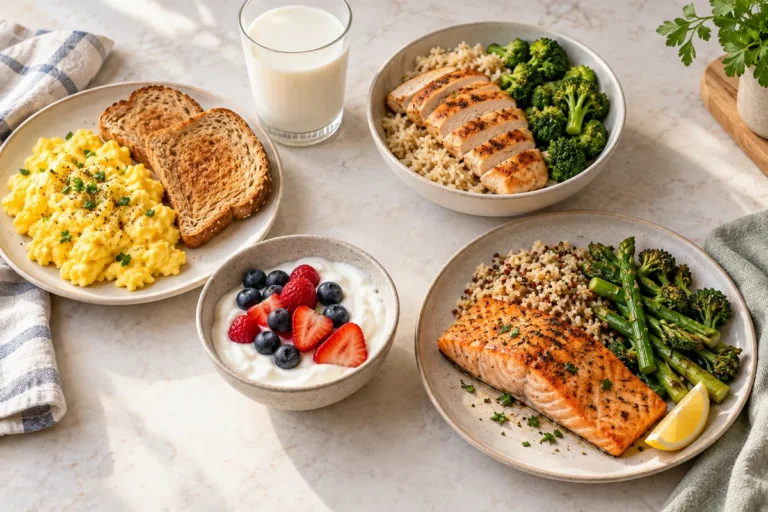
For example, breakfast might include Greek yogurt and eggs; lunch could be a chicken, tofu or bean bowl; a snack could be cottage cheese, edamame or a shake; and dinner could center on fish, tofu or another protein food. The exact amount varies by brand and serving size, so treat the meal numbers as targets rather than guaranteed totals for those foods.
If you prefer plant foods, combine options such as soy foods, beans, lentils, whole grains, nuts and seeds across the day. The U.S. guidelines encourage variety from both animal and plant sources. A powder is convenient when food alone is difficult, but it is optional.
Is 72 grams enough? Do you need 198 grams?
- 72 grams is the established 0.8 g/kg RDA calculation. It is a baseline reference, though it falls below the newer U.S. serving goal and common training ranges.
- 100 grams is above that RDA, but a little below the current U.S. guideline’s 108-gram lower end for 90 kg. It may be a practical step if your current intake is much lower.
- 135–145 grams sits within the U.S. guideline and also reaches the lower to middle part of the exercise range.
- 198 grams comes from the gym rule of one gram per pound, or about 2.2 g/kg. It is not a default requirement for every 90 kg adult.
Choose a range you can maintain while still eating enough fiber-rich foods and a varied diet. More grams are not automatically more useful.
Get a protein range for your routine
Enter your weight, activity level and goal in our free calculator.
When the formula needs extra care
These numbers are for generally healthy adults. Pregnancy, breastfeeding, serious illness and recovery from surgery can change needs. If you have chronic kidney disease, ask your care team before following a high-protein target: the NIDDK explains that protein needs vary with kidney disease and dialysis status.
Frequently asked questions
How much protein should a 90 kg man eat?
How much protein should a 90 kg woman eat?
Is 150 grams of protein too much at 90 kg?
Is 90 kg the same as 200 pounds?
Putting it into practice
At 90 kg, use 108–144 grams a day as the current U.S. guideline calculation. If you lift regularly, 126–180 grams is the sports-nutrition range; around 130–145 grams is a manageable starting point for many people. Let your training, calorie intake and health shape the final number.
This article provides general nutrition information and does not replace advice tailored to your medical history.
Sources
- Dietary Guidelines for Americans, 2025–2030, U.S. Department of Health and Human Services and U.S. Department of Agriculture.
- Dietary Reference Intakes for Macronutrients, National Academies.
- ISSN position stand: Protein and exercise, Journal of the International Society of Sports Nutrition, 2017.
- Protein supplementation and resistance training: Systematic review and meta-analysis, British Journal of Sports Medicine, 2018.
- Enhanced protein intake during weight loss: Systematic review and meta-analysis, Clinical Nutrition ESPEN, 2024.
- Healthy Eating for Adults with Chronic Kidney Disease, NIDDK.