Your daily protein needs depend on more than just your body weight. How active you are, the type of exercise you do, how frequently you train, your age, and your fitness goals can all affect how much protein you should consume.
For a healthy adult who does little or no structured exercise, the standard protein RDA is 0.8 grams per kilogram of body weight per day. People who exercise regularly generally need more. Sports-nutrition research commonly places protein intake for exercising adults around 1.4–2.0 grams per kilogram of body weight per day, with the appropriate amount depending on the type and intensity of training.
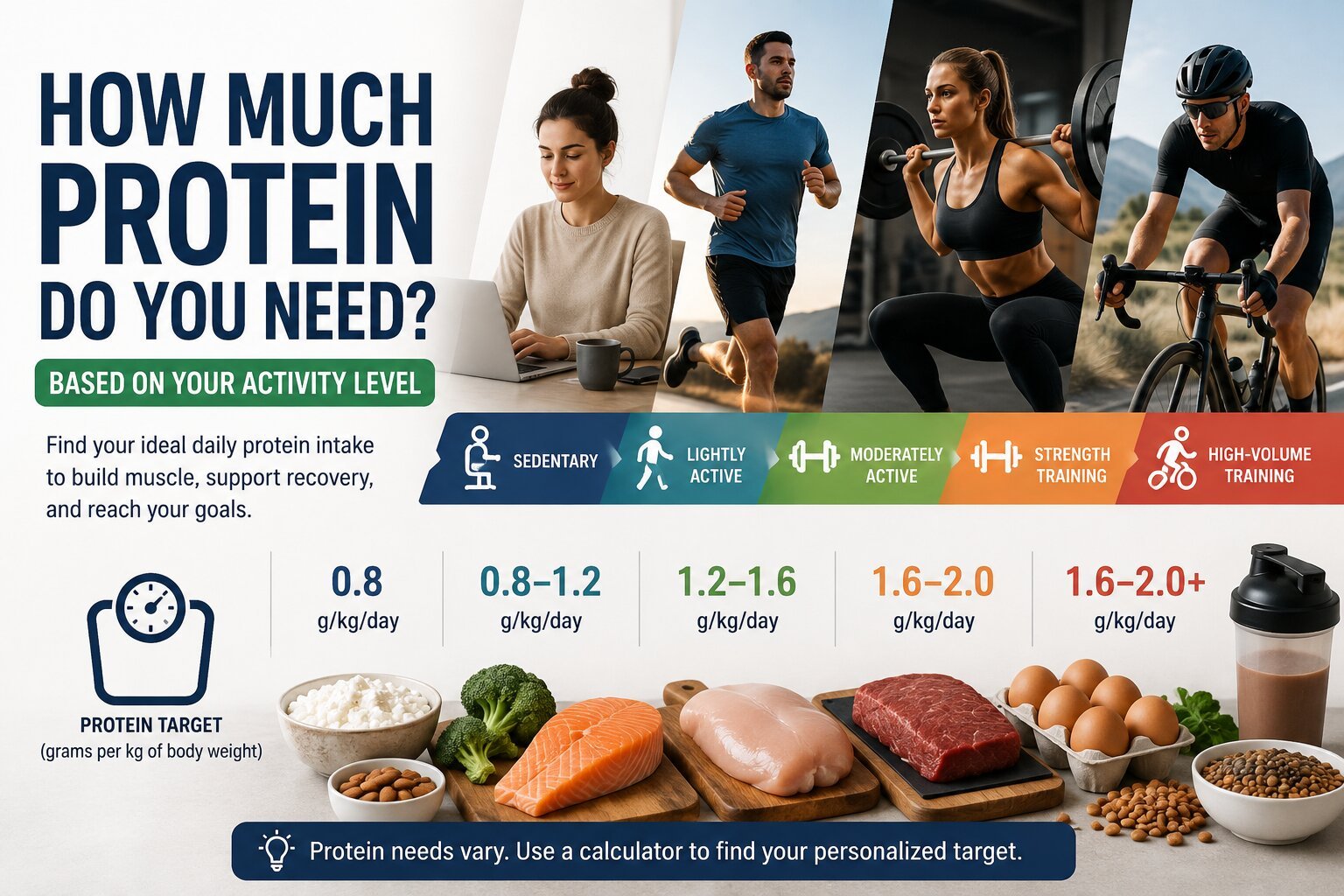
Quick Answer: How Much Protein Do You Need Based on Activity?
A useful starting framework for healthy adults is:
| Activity Level | Approximate Protein Target |
|---|---|
| Sedentary / little exercise | 0.8 g/kg/day |
| Lightly active | 0.8–1.2 g/kg/day |
| Regular recreational exercise | 1.2–1.6 g/kg/day |
| Endurance training | 1.4–1.8 g/kg/day |
| Strength / resistance training | 1.6–2.0 g/kg/day |
| High-volume or intense training | 1.6–2.0+ g/kg/day |
These are practical starting ranges rather than rigid official activity-level categories. Individual needs can vary with training volume, body composition, age, calorie intake, and goals.
If you are getting confused by all these and just want to calculate in a very simple way about your protein intake then you can use our protein calculator for free and get instant results
Why Does Activity Level Affect Protein Needs?
Protein is constantly being broken down and rebuilt in the body. Exercise changes this process.
Resistance training, running, cycling, swimming, sports, and other forms of physical activity can increase the need for tissue repair and adaptation. Protein supplies amino acids that the body uses to build and repair tissues, including skeletal muscle.
The important distinction is that exercise does not automatically mean you need huge amounts of protein. Instead, protein requirements generally increase as the amount and intensity of training increase.
Someone who walks for 30 minutes a few times per week has different nutritional demands from someone performing heavy resistance training five days per week.
Protein Needs by Activity Level
1. Sedentary: Little or No Structured Exercise
If you do not regularly exercise or participate in structured physical activity, you generally don’t need the higher protein intakes recommended for athletes.
The standard RDA for adults is:
0.8 grams of protein per kilogram of body weight per day
For example:
- 130 lb → about 47 g/day
- 150 lb → about 54 g/day
- 170 lb → about 62 g/day
- 180 lb → about 65 g/day
- 200 lb → about 73 g/day
- 220 lb → about 80 g/day
The Academy of Nutrition and Dietetics notes that the RDA for adults is 46 g/day for women and 56 g/day for men, although an individual’s needs can vary with factors such as activity level, age, and health status.
Who Does This Apply To?
This category may include someone who:
- Works at a desk
- Does little structured exercise
- Takes occasional walks
- Does not regularly participate in resistance or endurance training
Importantly, sedentary does not mean unhealthy. It simply describes a relatively low level of physical activity for the purpose of estimating protein needs.
2. Lightly Active: Walking and Occasional Exercise
If you exercise occasionally, walk regularly, or participate in light recreational activities, your protein needs may be somewhat higher than the basic RDA.
0.8–1.2 g/kg/day
For someone weighing 180 lb (81.6 kg), that would be approximately 65–98 grams of protein per day.
Examples of activity that might fit this category include:
- Regular walking
- Light cycling
- Occasional gym sessions
- Recreational activities
- Light fitness classes
- Exercise one or two times per week
3. Moderately Active: Regular Exercise
If you exercise several times per week, protein becomes more important for supporting recovery and adaptation.
A useful starting range is approximately:
1.2–1.6 g/kg/day
For a 180-pound (81.6 kg) person:
| Protein Target | Daily Protein |
|---|---|
| 1.2 g/kg | ~98 g |
| 1.4 g/kg | ~114 g |
| 1.6 g/kg | ~131 g |
This range may be appropriate for people who regularly participate in activities such as:
- Gym workouts
- Recreational sports
- Moderate cycling
- Running
- Fitness classes
- Combination cardio and resistance training
The more demanding the training becomes, the more useful it is to move toward the higher end of the range.
4. Endurance Training: Running, Cycling and Swimming
Endurance athletes have different nutritional demands from someone whose primary activity is strength training.
Running, cycling, swimming and other endurance activities involve repeated muscle contractions and can produce substantial training volume.
Sports-nutrition guidance generally places endurance athletes toward the lower-to-middle portion of the 1.4–2.0 g/kg/day range.
1.4–1.8 g/kg/day
For a 150-pound (68 kg) endurance athlete:
- 1.4 g/kg → 95 g/day
- 1.6 g/kg → 109 g/day
- 1.8 g/kg → 122 g/day
For a 180-pound (81.6 kg) athlete:
- 1.4 g/kg → 114 g/day
- 1.6 g/kg → 131 g/day
- 1.8 g/kg → 147 g/day
The International Society of Sports Nutrition specifically recommends that endurance athletes generally fall toward the lower end of the 1.4–2.0 g/kg/day range.
Don’t Forget Carbohydrates
More protein isn’t a substitute for adequate carbohydrate intake.
Carbohydrates are an important fuel source for endurance exercise, and inadequate energy or carbohydrate intake can change how the body uses protein. Sports nutrition therefore needs to consider the entire diet rather than protein in isolation.
5. Strength Training and Weightlifting
If you regularly lift weights or perform resistance training, your protein requirements are generally higher than those of someone who does little exercise.
1.6–2.0 g/kg/day
For a 180-pound (81.6 kg) lifter:
| Protein Intake | Daily Target |
|---|---|
| 1.6 g/kg | ~131 g |
| 1.7 g/kg | ~139 g |
| 1.8 g/kg | ~147 g |
| 1.9 g/kg | ~155 g |
| 2.0 g/kg | ~163 g |
The International Society of Sports Nutrition reports that 1.4–2.0 g/kg/day is sufficient for most exercising individuals, while strength and power athletes tend toward the upper end of that range.
This does not mean that eating 2.0 g/kg is automatically better than eating 1.6 g/kg.
Once you are consuming enough protein to support your training and overall nutrition, simply adding more protein doesn’t guarantee additional muscle growth.
6. High-Volume or Intense Training
Some athletes train much more frequently or intensely than the average recreational exerciser.
Examples include:
- Competitive weightlifters
- Bodybuilders
- High-volume endurance athletes
- Competitive CrossFit athletes
- Serious strength athletes
- Athletes training twice per day
- Athletes preparing for competition
For these individuals, a target toward the upper end of the sports-nutrition range can make sense:
1.6–2.0 g/kg/day
In certain situations—particularly during a calorie-restricted phase where an athlete is trying to preserve lean mass—research has examined substantially higher protein intakes.
The ISSN position stand notes that higher intakes, expressed relative to fat-free mass, may be useful for resistance-trained individuals during periods of calorie restriction.
Protein Needs by Exercise Type
One of the easiest ways to estimate your protein needs is to consider what kind of exercise you actually do.
| Exercise Type | Practical Starting Range |
|---|---|
| Little/no exercise | 0.8 g/kg |
| Walking/light activity | 0.8–1.2 g/kg |
| General fitness | 1.2–1.6 g/kg |
| Endurance training | 1.4–1.8 g/kg |
| Team/intermittent sports | 1.4–1.7 g/kg |
| Strength training | 1.6–2.0 g/kg |
| High-volume strength training | 1.6–2.0 g/kg |
These are ranges, not official activity-level categories. The sports-nutrition literature supports 1.4–2.0 g/kg/day for exercising adults and describes endurance athletes as tending toward the lower end, intermittent-sport athletes around the middle, and strength/power athletes toward the upper end.
What If You Do Both Cardio and Weight Training?
This is extremely common.
For example, you might:
- Lift weights 4 days per week
- Run 2 days per week
- Play basketball on weekends
In this situation, you don’t need a separate protein calculation for every workout.
Instead, consider your overall training load and primary goal.
1.6–2.0 g/kg/day
is a reasonable starting point for many healthy exercising adults when resistance training and muscle development are major priorities.
If your training is primarily endurance-focused, you may not need to push protein toward the very top of the range.
Does Your Fitness Goal Change How Much Protein You Need?
Yes. Activity level is only one part of the calculation. Your goal matters too.
Maintaining Muscle
If you’re active and simply trying to maintain your current muscle mass, you may not need the highest end of the protein range.
A moderate intake that consistently meets your needs can be sufficient.
Building Muscle
If you’re performing regular resistance training and trying to gain muscle, protein intake around 1.6–2.0 g/kg/day is a useful evidence-based target for many people.
But protein alone isn’t enough.
- Progressive resistance training
- Adequate calories
- Sufficient carbohydrates and fats
- Recovery
- Sleep
Losing Weight
Protein becomes particularly important when you’re dieting because preserving lean mass becomes a priority.
The ISSN notes that higher protein intakes may be useful for resistance-trained people during calorie restriction to help retain fat-free mass.
This is one reason a person’s protein target may need to be higher during a fat-loss phase than it would be during a period of weight maintenance.
Does Body Weight Matter?
Yes. Most protein recommendations are expressed relative to body weight.
Protein target = body weight in kg × protein target in g/kg
For example, suppose you weigh 180 lb.
First convert pounds to kilograms:
180 ÷ 2.205 = 81.6 kg
If you’re moderately active and choose a target of 1.4 g/kg:
81.6 × 1.4 = 114 g protein/day
If you’re resistance training and choose 1.8 g/kg:
81.6 × 1.8 = 147 g protein/day
So the same person could reasonably have different protein targets depending on their activity and training goal.
Protein Needs: Pounds vs. Kilograms
If you’re in the United States, you’re probably more comfortable thinking about body weight in pounds.
The conversion is:
1 kilogram = 2.205 pounds
To convert pounds to kilograms:
Body weight in pounds ÷ 2.205 = body weight in kilograms
Alternatively, you can use a pound-based protein multiplier.
For example:
- 1.6 g/kg ≈ 0.73 g/lb
- 1.8 g/kg ≈ 0.82 g/lb
- 2.0 g/kg ≈ 0.91 g/lb
The NIH Office of Dietary Supplements gives athletes a broader practical range of approximately 0.5–0.9 g/lb/day.
Example: Protein Needs for a 180-Pound Person
Let’s use one person to demonstrate how activity changes the calculation.
A 180-pound person weighs approximately 81.6 kg.
| Activity Level | Calculation | Approx. Protein |
|---|---|---|
| Sedentary | 81.6 × 0.8 | 65 g/day |
| Lightly active | 81.6 × 1.0 | 82 g/day |
| Moderately active | 81.6 × 1.4 | 114 g/day |
| Endurance training | 81.6 × 1.6 | 131 g/day |
| Strength training | 81.6 × 1.8 | 147 g/day |
| High-volume training | 81.6 × 2.0 | 163 g/day |
Notice what happened.
The person’s body weight didn’t change. Their activity level changed the estimated protein requirement.
That’s why simply asking “How much protein should I eat?” without considering activity can produce a less useful answer.
How Should You Spread Protein Throughout the Day?
Total daily protein is the first priority.
Once you’ve established your daily target, distributing protein across meals can make it easier to consistently consume enough.
The ISSN position stand describes general per-meal recommendations around 0.25 g/kg of high-quality protein or approximately 20–40 g, with individual needs varying based on body size, age, and training. It also discusses spreading protein intake across the day.
For example, someone targeting 150 g/day could divide it approximately like this:
| Meal | Protein |
|---|---|
| Breakfast | 35 g |
| Lunch | 40 g |
| Snack | 25 g |
| Dinner | 40 g |
| Evening snack | 10 g |
| Total | 150 g |
You don’t need to hit exactly the same number at every meal.
The bigger objective is to consistently reach your daily target.
Do You Need Protein Immediately After a Workout?
Probably not in the way social media sometimes suggests.
There is no need to panic if you don’t drink a protein shake within a few minutes of finishing your workout.
Protein consumed around exercise can support recovery and muscle protein synthesis, but the overall daily protein intake is more important than obsessing over a tiny post-workout window. The ISSN notes that the anabolic effects of resistance exercise persist well beyond the immediate workout period.
What About Protein Shakes?
You don’t need protein powder to meet your protein requirements.
Whole foods can provide plenty of protein, including:
- Chicken
- Turkey
- Beef
- Fish
- Eggs
- Greek yogurt
- Cottage cheese
- Milk
- Beans
- Lentils
- Tofu
- Tempeh
- Nuts and seeds
The Academy of Nutrition and Dietetics notes that most people can obtain their protein from food, while protein supplements can be convenient when dietary intake is difficult to achieve.
Does More Protein Always Mean More Muscle?
No.
Increasing protein from a very low intake to an adequate intake can be useful. Increasing protein from an already adequate intake to an unnecessarily high intake doesn’t automatically produce proportionally greater muscle growth.
Muscle growth depends on multiple factors:
- Resistance training
- Adequate protein
- Adequate calories
- Training progression
- Recovery
- Sleep
- Overall diet
Eating more protein by itself does not make someone stronger. Protein works together with resistance training and adequate overall nutrition.
What About Older Adults?
Age can change the picture.
Older adults may benefit from somewhat higher protein intakes because the body’s response to dietary protein and muscle-building stimuli can change with age.
The PROT-AGE expert group recommends at least 1.0–1.2 g/kg/day for healthy adults over 65, with at least 1.2 g/kg/day recommended for older adults who are exercising and active.
The American College of Sports Medicine similarly reports 1.0–1.2 g/kg for adults over 50, with needs potentially increasing to around 1.5 g/kg during heavier training.
Older adults shouldn’t necessarily use the basic 0.8 g/kg RDA as their only reference point. Individual health and dietary circumstances matter.
What If You’re Trying to Lose Fat?
Activity level isn’t the only thing that matters when you’re losing weight.
During a calorie deficit, maintaining adequate protein and performing resistance training can help preserve lean mass.
For active people who are dieting, the upper end of the normal sports-nutrition range may be useful. Research summarized by the ISSN has found that higher protein intakes can be useful for preserving fat-free mass during calorie restriction in resistance-trained individuals.
How to Calculate Your Protein Needs
The basic calculation is simple:
Step 1: Convert Your Weight to Kilograms
Weight in pounds ÷ 2.205 = weight in kilograms
Step 2: Choose an Appropriate Protein Range
- Little exercise → around 0.8 g/kg
- General fitness → around 1.2–1.6 g/kg
- Endurance training → around 1.4–1.8 g/kg
- Strength training → around 1.6–2.0 g/kg
Step 3: Multiply
Body weight in kg × protein target = grams of protein per day
For example:
180 lb ÷ 2.205 = 81.6 kg
For a strength-training target of 1.8 g/kg:
81.6 × 1.8 = 147 g/day
So the estimated daily target would be approximately:
147 grams of protein per day
The Best Protein Target Depends on You
There isn’t one perfect protein number that applies to everyone.
Two people who both weigh 180 pounds can have very different protein needs.
Person A
- 180 lb
- Desk job
- Little exercise
- No structured training
A target around 65 g/day based on the basic 0.8 g/kg RDA may be a reasonable baseline.
Person B
- 180 lb
- Strength trains 5 days/week
- Trying to build muscle
A target around 130–160 g/day may be much more appropriate.
Same body weight. Different activity. Different protein requirement.
That’s why protein calculators can be more useful than relying on a single protein number you see online.
Frequently Asked Questions
How much protein do I need if I don’t exercise?
The standard adult RDA is 0.8 g/kg of body weight per day. Your individual needs can vary based on age, health status, and other factors.
How much protein do I need if I work out 3 times a week?
A practical starting point for someone doing regular recreational exercise is approximately 1.2–1.6 g/kg/day, depending on the type and intensity of training.
How much protein do I need if I lift weights?
For regular resistance training, approximately 1.6–2.0 g/kg/day is a useful evidence-based range for many healthy adults.
How much protein do runners need?
Endurance athletes generally fall toward the lower portion of the sports-nutrition range, with approximately 1.4–1.8 g/kg/day being a practical range for many runners and other endurance athletes.
Do athletes need more protein than sedentary people?
Generally, yes. Exercise increases the body’s need for protein to support tissue repair, adaptation, and maintenance.
Is 1 gram of protein per pound enough?
For many active people, 1 g/lb is already a relatively high intake. It is approximately 2.2 g/kg, which is above the 1.4–2.0 g/kg range generally recommended for most exercising individuals. More is not automatically better.
Can I get enough protein from food?
Yes. Most people can meet their protein requirements through a varied diet containing meat, fish, eggs, dairy, beans, lentils, soy, nuts, and seeds. Protein supplements can be useful for convenience but aren’t mandatory.
Should I eat protein after every workout?
Including protein around your training can support recovery, but your total daily protein intake is the bigger priority. You don’t need to obsess over a few-minute post-workout window.
Calculate Your Protein Needs
Your protein requirement depends on more than your weight.
Your:
- Body weight
- Activity level
- Exercise type
- Training frequency
- Fitness goal
- Age
can all influence the amount that makes sense for you.
Calculate Your Daily Protein Needs →
Bottom Line
For most healthy adults, the basic protein RDA is 0.8 g/kg/day. Once you become regularly active, your protein needs generally increase.
| Activity Level | Starting Range |
|---|---|
| Sedentary | ~0.8 g/kg |
| Light activity | ~0.8–1.2 g/kg |
| General fitness | ~1.2–1.6 g/kg |
| Endurance training | ~1.4–1.8 g/kg |
| Strength training | ~1.6–2.0 g/kg |
| High-volume training | ~1.6–2.0+ g/kg in some circumstances |
These are starting ranges rather than rigid rules. The best target depends on your individual training, body composition, age, calorie intake, and goals.
Here are the reliable sources that our team used to gather the information from
NIH ODS — Exercise and Athletic Performance