Quick Answer
Probably—but not for the reason TikTok told you.
If you’re constantly hungry, struggling to recover after workouts, or wondering whether your body is trying to send you a message, low protein intake could be one of the reasons. The keyword is could. Many of these signs can have several different causes, so it’s important not to jump to conclusions after reading a list on the internet (yes, even this one).
That’s why we took a different approach. Instead of copying the same “5 signs” article you’ll find everywhere else, we dug into peer-reviewed research, nutrition guidelines, and sports nutrition position papers to separate myths from evidence.
To make everything easier to understand, we’ve also added our own state-of-the-art humour, so you can learn about protein without needing a nutrition degree—or developing a headache from overly technical terms.
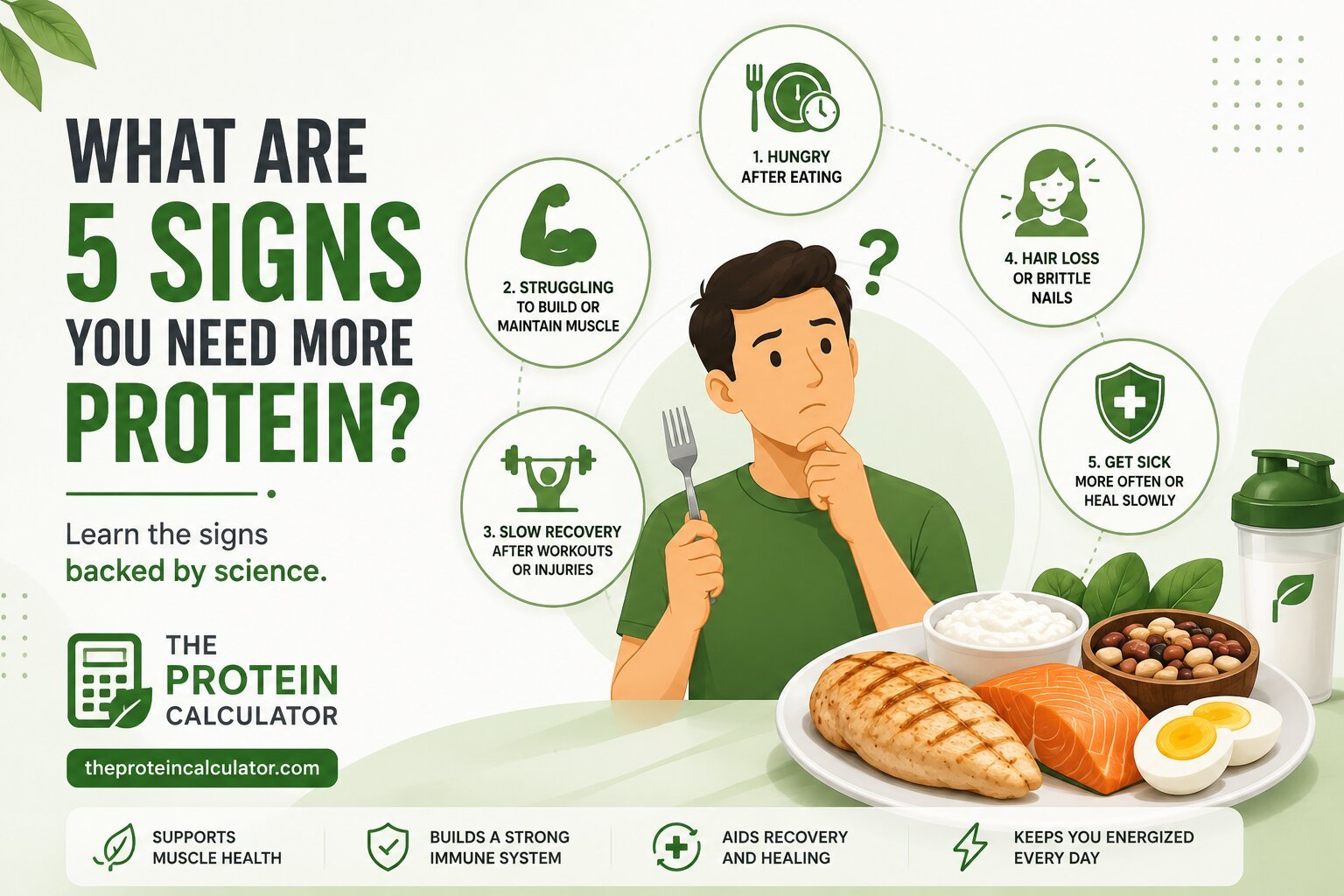
In this guide, we’ll explain the five most common signs that you need protein and what the science actually says, and how to find out whether your protein intake is where it should be.
1. You Feel Hungry Soon After Eating
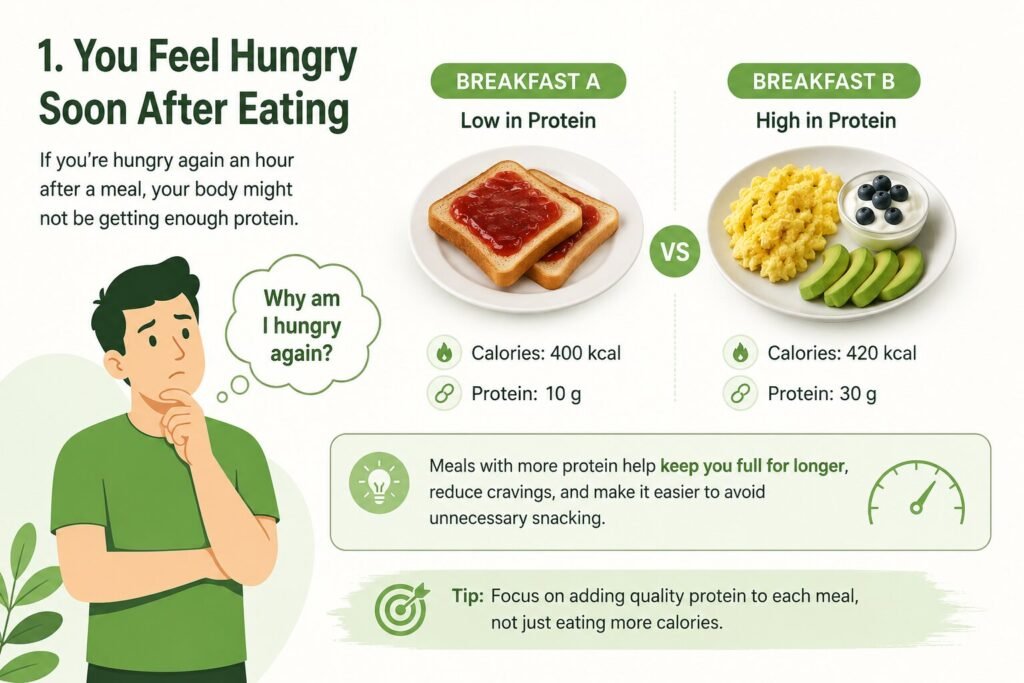
If you find yourself reaching for a snack an hour or two after a meal, your protein intake could be part of the reason.
Protein is the most satiating of the three macronutrients (protein, carbohydrates, and fats). Compared with meals that are low in protein, meals containing an adequate amount of protein generally help you feel fuller for longer. This happens because protein slows stomach emptying and influences hormones involved in appetite regulation, including GLP-1, peptide YY (PYY), and ghrelin (often called the “hunger hormone”).
For example, imagine these two breakfasts that contain roughly the same number of calories:
- Breakfast A: A bagel with jam.
- Breakfast B: Greek yogurt topped with berries and a handful of nuts.
Although both breakfasts may contain a similar number of calories, Breakfast B is much more likely to keep your stomach from staging a dramatic protest by 10:30 a.m.
Think of it this way: a breakfast of toast and jam is like inviting a guest who says, “I’ll just stay for five minutes,” and then disappears before you’ve finished your coffee. A protein-rich breakfast, on the other hand, is the dependable friend who sticks around and keeps everything under control.
So, if you’re opening the office snack drawer, negotiating with the biscuit tin, or wondering whether it’s socially acceptable to eat lunch at 10:47 a.m., don’t automatically assume you need more food. It may simply be that your meals need more protein.
2. You’re Struggling to Build or Maintain Muscle
If you’ve been strength training consistently but aren’t seeing the progress you expected, your protein intake could be one of the reasons.
Your muscles are constantly going through a natural cycle of breakdown and repair. Every workout creates tiny amounts of muscle damage, and your body uses amino acids—the building blocks of protein—to repair those muscle fibers and help them become stronger over time. Without enough dietary protein, this repair process becomes less efficient.
This doesn’t just affect people trying to build muscle. Protein is equally important for maintaining the muscle you already have, especially if you’re:
- Trying to lose weight.
- Over the age of 40.
- Recovering from an injury.
- Physically active several times a week.
Your muscles are a bit like a construction site. Every workout is basically your gym saying, “Congratulations! We’ve made tiny holes in your muscles. Good luck fixing them.” Your body then sends in the repair crew—and protein is the truck carrying all the building materials.
Now imagine the repair crew arrives… but the truck is empty.
The workers look at each other, shrug, have a cup of tea, and leave.
That’s essentially what can happen if your body doesn’t get enough protein over time. It still tries to repair and maintain muscle, but it has fewer raw materials to work with.
Here’s a simple example.
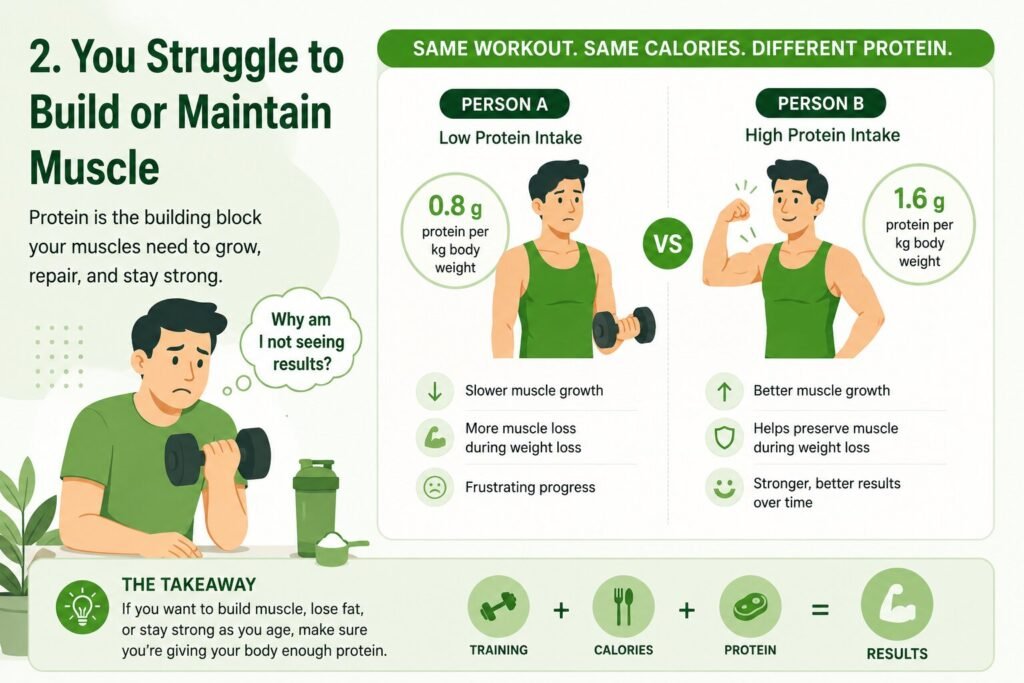
Meet Alex and Ben. They hit the gym together, follow the exact same workout plan, and even eat the same number of calories every day.
The only difference?
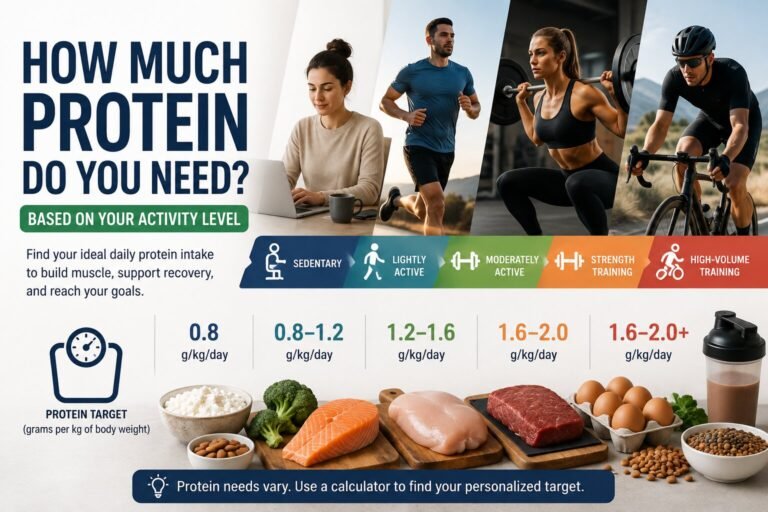
- Alex eats about 0.8 grams of protein per kilogram of body weight.
- Ben eats around 1.6 grams per kilogram while following the same training routine.
Fast forward a few months.
Ben is gradually building strength and holding onto more muscle, while Alex is left wondering if the dumbbells are secretly getting heavier every week. Assuming everything else is equal, research suggests Ben’s higher protein intake gives his body a better chance of repairing and maintaining muscle.
The lesson? You don’t need to start carrying a rotisserie chicken everywhere you go, but if you’re trying to build muscle, lose fat, or simply stay strong as you get older, giving your body enough protein is like making sure the construction crew actually has bricks to build with—not just good intentions.
If you’re lifting weights, trying to build muscle, or simply want to maintain your strength as you age, guessing your protein intake isn’t the best approach.
Use our Protein Calculator to estimate your ideal daily protein intake based on your weight, activity level, and fitness goals. Once you know your target, you can compare it with what you’re currently eating and make informed adjustments instead of relying on guesswork.
Read More About Protein
- How Is Protein Intake Calculated?
- How Much Protein a Day for 70 kg?
- What Is the Unhealthiest Protein? The Protein Sources You May Want to Limit
- How Much Protein Do I Need Based on My Activity Level?
- How Much Protein Do Sardines Have?
3. Your Muscles Take Longer to Recover After Exercise
Exercise—especially resistance training—creates tiny tears in your muscle fibers. This is a normal part of the muscle-building process. During recovery, your body repairs these fibers using amino acids from the protein you eat, helping your muscles adapt and become stronger over time.
Think of your muscles like a road that’s being repaired after a busy day of traffic. Every workout leaves behind a few “potholes” that your body needs to fix before you’re ready to hit the gym again. Protein is the construction material that helps fill those potholes.
Now imagine you’ve just survived Monday’s legendary leg day.
You know… the one where sitting on the toilet feels like an Olympic event.
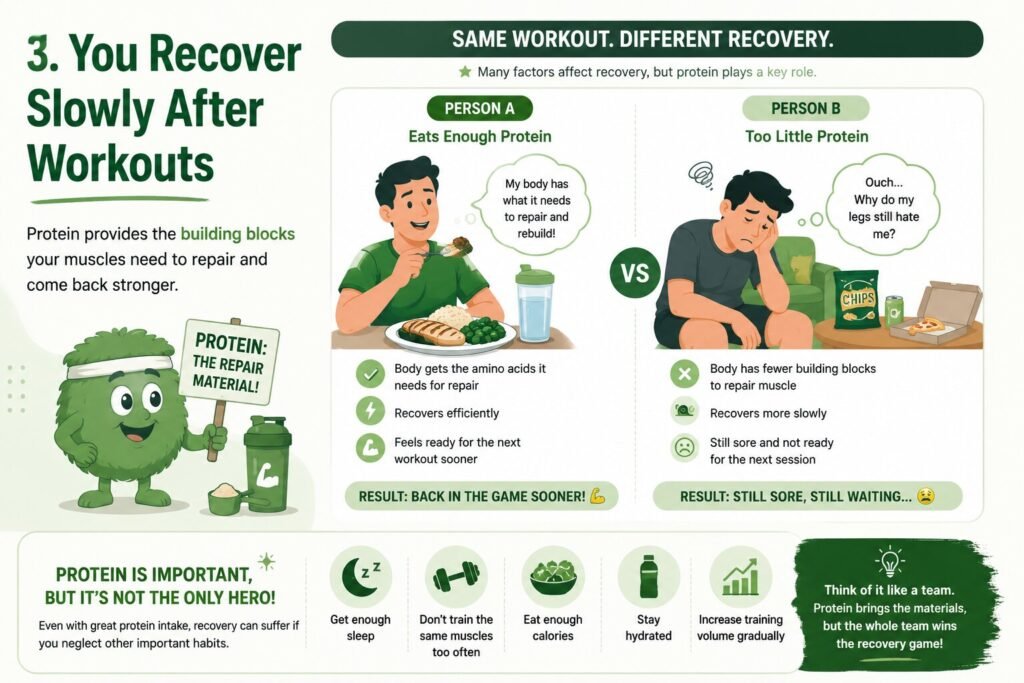
Meet Sarah and Mike.
They both did the exact same workout. Same squats. Same lunges. Same amount of complaining afterwards.
The only difference?
- Sarah eats enough protein throughout the day and has balanced meals.
- Mike celebrates leg day with a packet of chips and the confidence that “I’ll be fine.“
A couple of days later, Sarah is back in the gym ready for another session. Mike is still grabbing the handrail every time he walks downstairs and wondering if elevators should become mandatory.
Of course, protein isn’t some magical recovery potion. Your muscles also need good sleep, enough calories, proper hydration, and enough time to recover between workouts. Even if your protein intake is perfect, recovery can still be slower if you:
- Stay up until 2 a.m. binge-watching “just one more episode.”
- Train the same muscles every single day.
- Eat too few calories overall.
- Forget that water exists.
- Suddenly decide you’re training like a professional athlete after spending the last six months on the sofa.
Protein gives your body the raw materials to repair your muscles—but like any good construction project, it also needs enough time, energy, and a competent project manager (that’s you).
Could Your Protein Intake Be Limiting Your Recovery?
If you exercise regularly, your protein requirements are often higher than those of someone with a sedentary lifestyle.
Instead of guessing, use our Protein Calculator to estimate how much protein you need each day based on your weight, activity level, and fitness goals. Knowing your target can help you determine whether your current diet is providing enough protein to support recovery and long-term progress.
4. Your Hair and Nails Seem Weaker Than Usual
If you’ve noticed that your hair feels thinner than usual or your nails break more easily, you may have come across articles claiming that you simply need more protein. While protein does play an important role, the reality is a bit more nuanced.
Your hair and nails are basically your body’s way of saying, “We’re made of protein too, you know!” In fact, your hair is made mostly of a protein called keratin, and your nails are built from tough structural proteins. So yes, your body does need enough protein to help keep them healthy.
But before you sprint to the supermarket and buy every protein shake on the shelf because you found an extra hair in the shower drain… let’s slow down for a second.
Hair loss and brittle nails are a bit like your car’s check engine light. It tells you that something might need attention, but it doesn’t tell you exactly what the problem is.
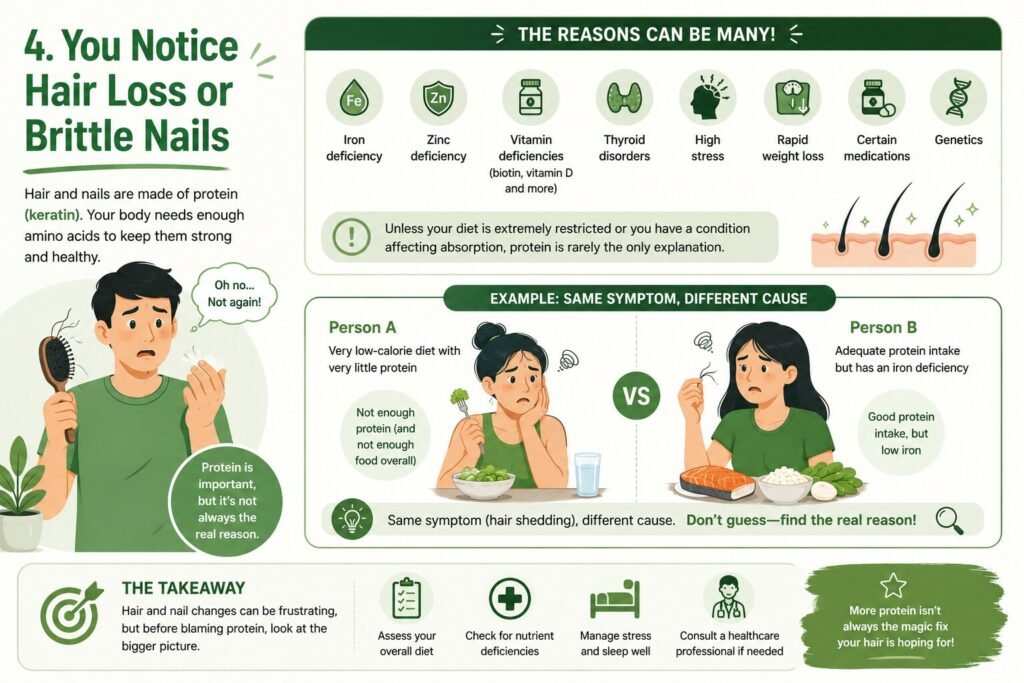
The culprit could be:
- Iron deficiency.
- Zinc deficiency.
- Low levels of vitamins such as biotin or vitamin D.
- Thyroid problems.
- Hormonal changes.
- High stress.
- Rapid weight loss.
- Certain medications.
- Or sometimes… you can thank your parents and their genetics.
Here’s a simple example.
Meet Emma and Lisa.
Both notice they’re losing more hair than usual.
Emma has been following an extremely low-calorie diet where a lettuce leaf is practically considered dinner. Along with eating very little overall, she’s also not getting enough protein.
Lisa, on the other hand, eats plenty of protein every day but has developed an iron deficiency.
Same symptom. Completely different reason.
That’s why blaming every loose strand of hair on low protein is a bit like blaming your Wi-Fi because your TV remote stopped working. They might both be annoying, but they’re probably not related.
Before assuming protein is the problem, it’s worth finding out whether you’re actually eating enough in the first place. If your protein intake is already adequate, increasing it further probably won’t be the magic fix your hair was hoping for.
5. You Seem to Get Sick More Often or Heal More Slowly
Protein isn’t just important for building muscle—it also plays a vital role in supporting your immune system.
Most people think protein’s only job is helping you build bigger muscles. But that’s a bit like saying your smartphone is only good for making phone calls.
Your body also uses protein to make antibodies, enzymes, and immune cells—the tiny superheroes that help fight off bacteria, viruses, and other unwanted visitors. Protein also helps repair damaged tissues, which is why it’s especially important when you’re recovering from an injury or even a small cut.
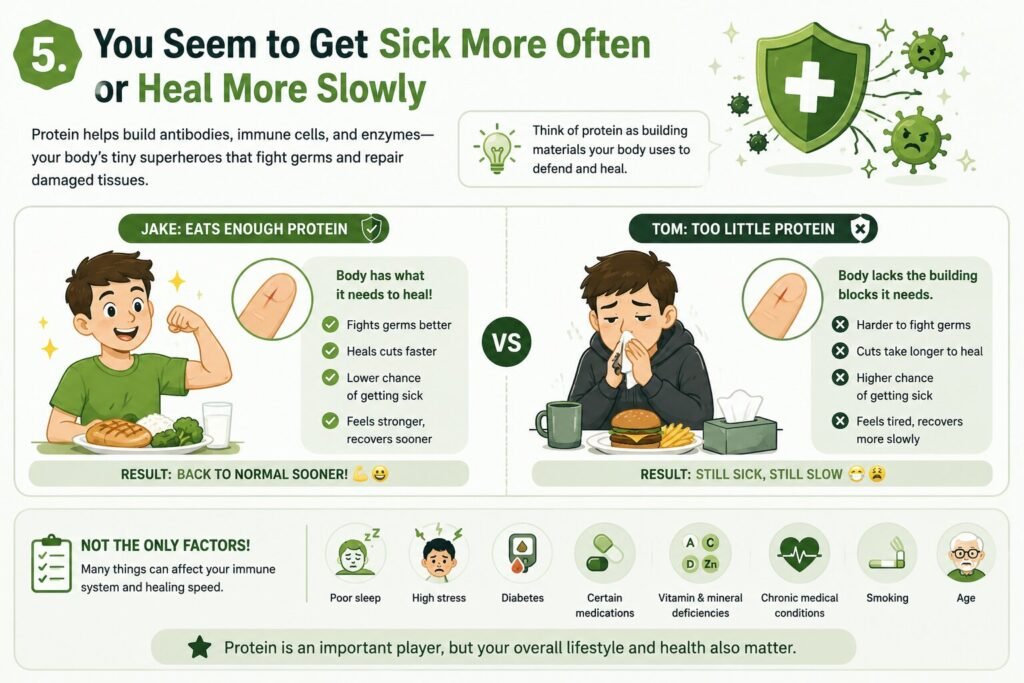
Imagine two friends, Jake and Tom, who both accidentally discover that paper really can cut skin.
They end up with the same tiny cut on their finger.
- Jake eats a balanced diet with enough protein every day.
- Tom regularly skips protein-rich foods and falls well below his daily needs.
Who’s more likely to give their body the building materials needed to repair that cut?
Jake.
His body has a better supply of amino acids—the raw materials needed to support normal tissue repair. Tom’s body can still heal, but if his protein intake has been consistently low for a long time, it may not have the same resources available.
Now, before you start blaming every cold on the fact that you skipped chicken yesterday, here’s the important part.
Getting sick more often or healing slowly doesn’t automatically mean you need more protein. Your immune system is influenced by a whole team of players, not just one nutrient.
Things like these can also make a difference:
- Sleeping five hours a night because “I’ll catch up this weekend.“
- Constant stress (your inbox counts).
- Diabetes.
- Certain medications.
- Vitamin and mineral deficiencies.
- Long-term health conditions.
- Smoking.
- Simply getting older.
Think of your immune system like a football team. Protein is definitely one of the star players—but even the best striker can’t win the match if the goalkeeper forgot to show up and half the team is injured.
That’s why doctors don’t diagnose low protein intake based on a single symptom. They look at your overall diet, lifestyle, medical history, and health before deciding what’s really going on.
Find Out If You’re Eating Enough Protein
Your immune system depends on many nutrients, but ensuring you’re meeting your daily protein needs is a good place to start.
Use our Protein Calculator to estimate your ideal daily protein intake based on your weight, activity level, age, and fitness goals. Knowing your target can help you make informed dietary choices instead of relying on symptoms or guesswork.
How We Collected and Analysed the Evidence
This guide was written using evidence from peer-reviewed research, nutrition textbooks, systematic reviews, and position statements from leading health and sports nutrition organizations. Rather than relying on social media claims or anecdotal advice, we reviewed high-quality scientific sources to explain what the current evidence says about protein intake and the signs that may be associated with inadequate protein consumption.
| Topic | Main References |
|---|---|
| Feeling hungry after meals | NCBI Recommended Dietary Allowance (RDA) Chapter, Phillips Review, EatingWell |
| Difficulty building or maintaining muscle | International Society of Sports Nutrition (ISSN) Position Stand, Phillips Review |
| Slow workout recovery | ISSN Position Stand, Systematic Review on Exercise Recovery |
| Hair and nails | NCBI Recommended Dietary Allowance (RDA) Chapter, general nutrition evidence on protein’s structural role |
| Getting sick more often | NCBI Recommended Dietary Allowance (RDA) Chapter, ISSN Position Stand, EatingWell |