One hundred grams of protein can sound like a lot when it is just a number in an app. On a plate, it looks much more ordinary: eggs and milk at breakfast, a turkey sandwich for lunch, yogurt as a snack, and chicken with rice at dinner.
Here is the key distinction: 100 grams of protein is the amount of the nutrient across your whole day, not the weight of one piece of food. A 3-ounce portion of cooked turkey weighs about 85 grams but contains roughly 25 grams of protein.
Quick answer: One example day is 20 grams at breakfast, 33 grams at lunch, 17 grams from a snack, and 30 grams at dinner. That adds up to about 100 grams of protein. The figures are rounded estimates, so your actual total will vary with portions and brands.
100 grams of protein, pictured in four meals
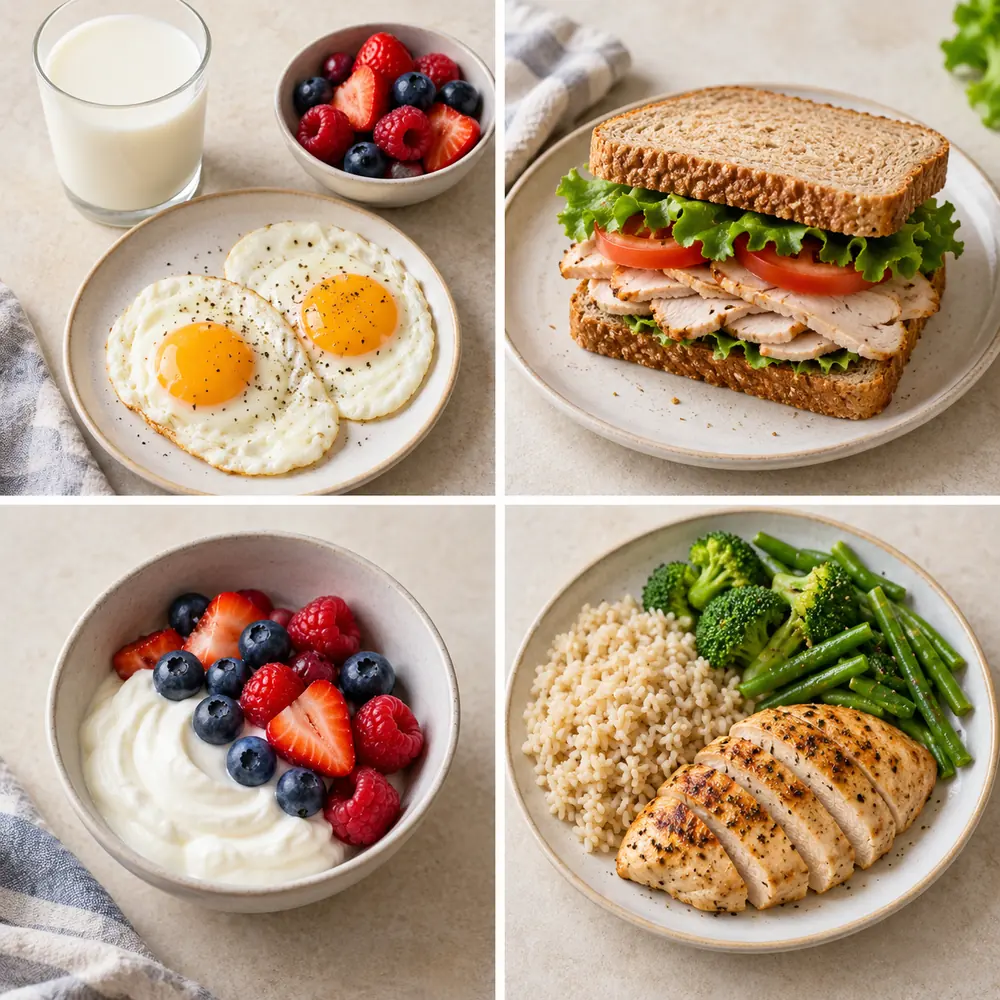
Visual total: 20 + 33 + 17 + 30 = 100 g of protein from the foods counted. Berries and vegetables pictured may add small amounts beyond this tally.
What does 100 grams of protein look like across a day?
This example uses familiar US grocery foods. The meat portions below are cooked weights; the yogurt serving refers to the weight on the container. Fruit, vegetables, condiments, and cooking oil can round out the meals, but their small or variable protein contributions are not included in this simple tally.
Breakfast: Eggs and milk — about 20 g
| Food | Portion | Approximate protein |
|---|---|---|
| Eggs | 2 large | 12 g |
| Milk | 1 cup (8 fl oz) | 8 g |
| Breakfast total | 20 g | |
Scramble the eggs, drink the milk, and add fruit or toast if you like. Two eggs alone provide about 12 grams; the milk brings the meal closer to 20.
Lunch: Turkey sandwich — about 33 g
| Food | Portion | Approximate protein |
|---|---|---|
| Roasted turkey breast | 3 oz cooked (about 85 g) | 25 g |
| Whole-wheat bread | 2 slices | 8 g |
| Lunch total | 33 g | |
Add lettuce, tomato, or another vegetable to the sandwich. The turkey estimate is for roasted turkey breast; packaged deli turkey can differ in both protein and sodium, so use its Nutrition Facts label if that is what you buy.
Running total after lunch: about 53 g.
Afternoon snack: Plain Greek yogurt — about 17 g
| Food | Portion | Approximate protein |
|---|---|---|
| Plain Greek yogurt | One 5.3–6 oz container (about 150–170 g) | 17 g |
| Snack total | 17 g | |
Greek yogurt is an easy option between meals. Protein varies substantially across brands and container sizes; choose one whose label lists about 17 grams if you want this example to add up as shown.
Running total after the snack: about 70 g.
Dinner: Chicken, rice, and vegetables — about 30 g counted
| Food | Portion | Approximate protein |
|---|---|---|
| Skinless chicken breast | 3 oz cooked (about 85 g) | 26 g |
| Cooked rice | 1 cup | 4 g |
| Dinner total from these foods | 30 g | |
Serve the chicken and rice with vegetables you enjoy. Those vegetables may add a few more grams, depending on the type and portion. That is why the real plate can come out a little above 100 grams even though the counted foods below total 100.
The full day at a glance
| Meal | Protein counted | Running total |
|---|---|---|
| Breakfast | 20 g | 20 g |
| Lunch | 33 g | 53 g |
| Snack | 17 g | 70 g |
| Dinner | 30 g | 100 g |
The numbers are intentionally rounded. You do not need to hit exactly 100.0 grams every day to eat enough protein for your own needs.
How much food is 100 grams of protein?
There is no single volume or plate size. Protein is present in different concentrations across foods. Use this comparison to visualize portions that each provide part of a day’s protein—these are options, not a suggestion to eat all of them at once.
| Food | Typical portion | Approximate protein |
|---|---|---|
| Large eggs | 2 eggs | 12 g |
| Milk | 1 cup | 8 g |
| Roasted turkey breast | 3 oz cooked | 25–26 g |
| Cooked chicken breast | 3 oz cooked | About 26 g |
| Plain Greek yogurt | One small container, depending on label | About 15–18 g |
| Cooked lentils | 1 cup | About 18 g |
The practical lesson is to combine foods. For example, two eggs are nutritious, but they contribute about 12 grams rather than the entire 100-gram target. A meal with several protein-containing foods can bring the day’s total up without an enormous serving of any one item.
Do you need 100 grams of protein a day?
Maybe, but 100 grams is not a universal requirement. Your weight, activity, age, goals, and medical circumstances matter. The longstanding adult Recommended Dietary Allowance is 0.8 gram per kilogram of body weight per day, while the current US Dietary Guidelines give a general target of 1.2–1.6 g/kg per day. Guidance for many athletes is often around 1.2–2.0 g/kg per day. These figures answer different questions and should not be treated as a prescription for every person.
For a person weighing 150 pounds (about 68 kg), 100 grams works out to roughly 1.47 g/kg. For a person weighing 200 pounds (about 91 kg), the same 100 grams is roughly 1.10 g/kg. The number stays the same, but how it fits the person’s needs changes.
If your question is whether this target fits you, read our guide to whether 100 grams of protein is enough. You can also use our free protein calculator to get a starting range based on your details.
Find a protein target that fits you
The day above shows what 100 grams can look like. Enter your weight, activity level, and goal to estimate a more personal daily range.
Can you get 100 grams without protein powder?
Yes. The example day reaches approximately 100 grams with ordinary foods and no powder. A shake can be convenient when you have a gap to fill, but it is not a required part of this target.
| Approach | What it offers | What to check |
|---|---|---|
| Food across meals | Protein alongside other nutrients and a variety of tastes and textures | Portion size, preparation, and an overall balanced diet |
| Protein shake | A convenient way to add protein when a meal falls short | Protein per serving and whether you actually need the extra amount |
When you plan your own day, swap foods based on preference and budget. Milk can become a fortified soy drink with comparable protein if its label supports the swap. Beans, lentils, tofu, and edamame can contribute to a plant-based day, though portions and brands need to be recalculated. For more ways to build a higher target, see what 120 grams of protein looks like.
Three things that make protein totals misleading
- Mixing up food weight and protein weight: A 100-gram piece of chicken is not 100 grams of protein. The protein is one part of that food’s weight.
- Comparing raw and cooked meat weights: Meat loses water as it cooks. If a guide says 3 ounces cooked, weigh it after cooking or use a nutrition entry for the raw amount you measured.
- Assuming every brand matches a generic table: Yogurt, bread, milk alternatives, deli meat, and tofu can vary. The package label is more useful for a product you actually eat.
A helpful way to use this guide: Treat 100 grams as a picture of one possible day. Build meals you like, check the portions, and compare the day’s total with a target that fits your body and goals.
Frequently asked questions
What does 100 grams of protein look like for breakfast, lunch, and dinner?
One way is about 20 grams at breakfast, 33 grams at lunch, 17 grams in a snack, and 30 grams at dinner. You can move those amounts between meals; the total across the day is the main point of this example.
Is 100 grams of protein the same as 100 grams of chicken?
No. The first number describes the nutrient; the second describes the weight of the chicken. Cooked chicken breast contains roughly 26 grams of protein in a 3-ounce (85-gram) portion, with some variation.
Can I reach 100 grams of protein without eating meat?
Yes, but the exact portions will change. Eggs and dairy can help in a vegetarian diet; tofu, tempeh, soy foods, beans, lentils, and other foods can be combined in a vegan diet. Read the label on packaged foods and add up the portions you actually eat.
Is 100 grams of protein too much?
There is no useful yes-or-no answer without context. For many healthy adults it can fit within an appropriate range; for others it may be more or less than needed. If you have chronic kidney disease or another condition that affects your diet, ask your clinician or registered dietitian for a personal target before increasing protein.
The takeaway
One hundred grams of protein does not require one giant steak or a stack of shakes. In this example, everyday meals add up to about 100 grams: 20 at breakfast + 33 at lunch + 17 from a snack + 30 at dinner. Use it to visualize portions, then adjust the foods and target to suit your needs.
Sources and notes on the numbers
- USDA FoodData Central and the USDA National Agricultural Library’s protein-by-household-measure reference for representative values for eggs, milk, roasted turkey, whole-wheat bread, and cooked rice. Values are rounded; check a food’s current database entry or product label when tracking closely.
- Dietary Guidelines for Americans, 2025–2030 for the current general 1.2–1.6 g/kg protein target.
- NIH Office of Dietary Supplements: Exercise and Athletic Performance for the athlete protein range.
- NIDDK: Healthy Eating for Adults with Chronic Kidney Disease for the need to individualize protein intake in kidney disease.
Editorial calculation note: The example uses about 26 g for 3 oz of cooked chicken breast and a yogurt container labeled 17 g protein. Side dishes beyond the listed rice and bread are excluded from the 100 g arithmetic. Protein content varies by food and preparation.