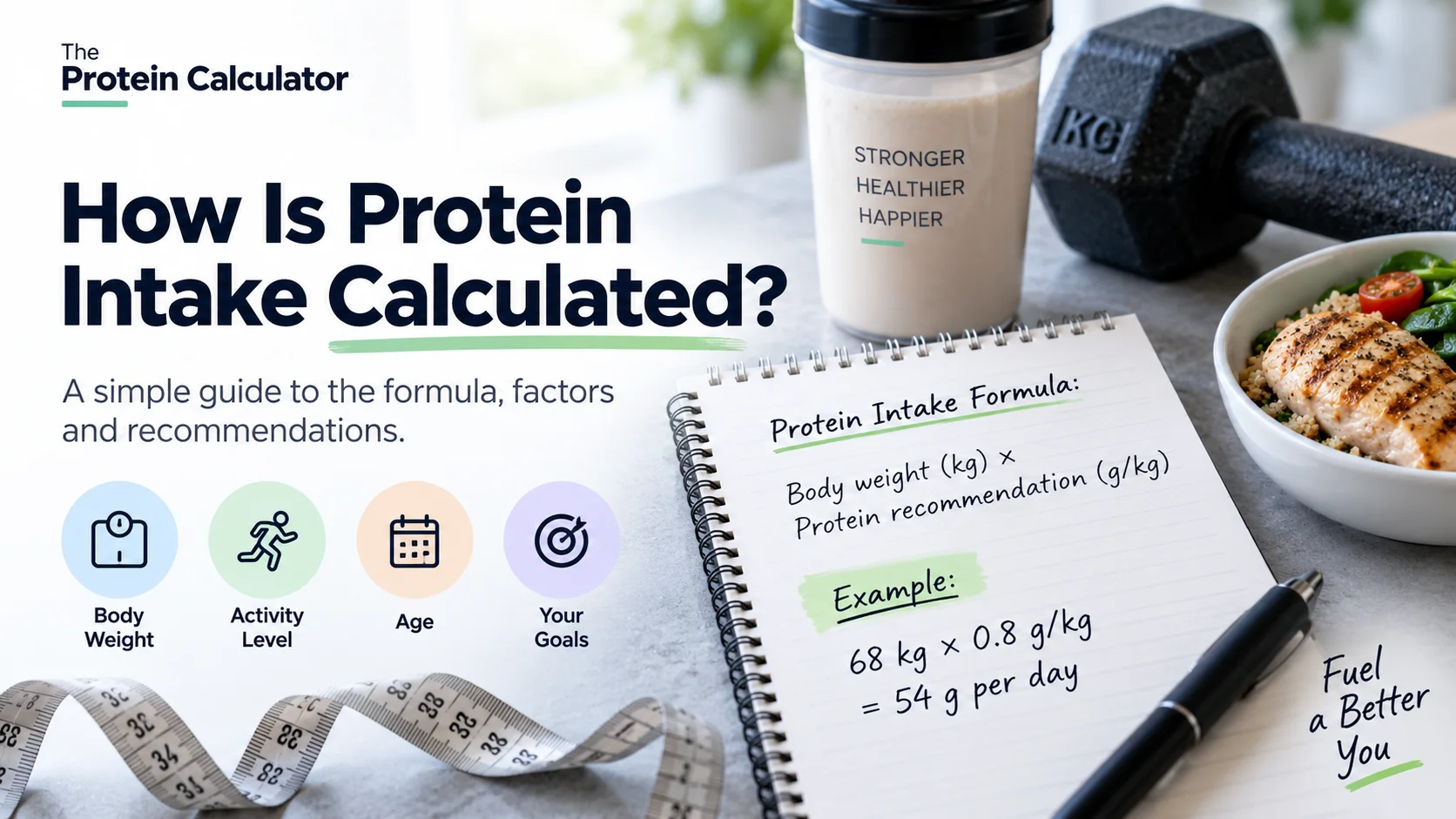
Protein recommendations can look confusing because different people may need different amounts. A person’s body weight, activity level, age, and fitness goals can all affect how much protein may be appropriate.
So how is protein intake actually calculated?
For most adults, a protein target can be estimated by multiplying body weight in kilograms by a recommended number of grams of protein per kilogram of body weight.
The Basic Protein Calculation
The basic formula is:
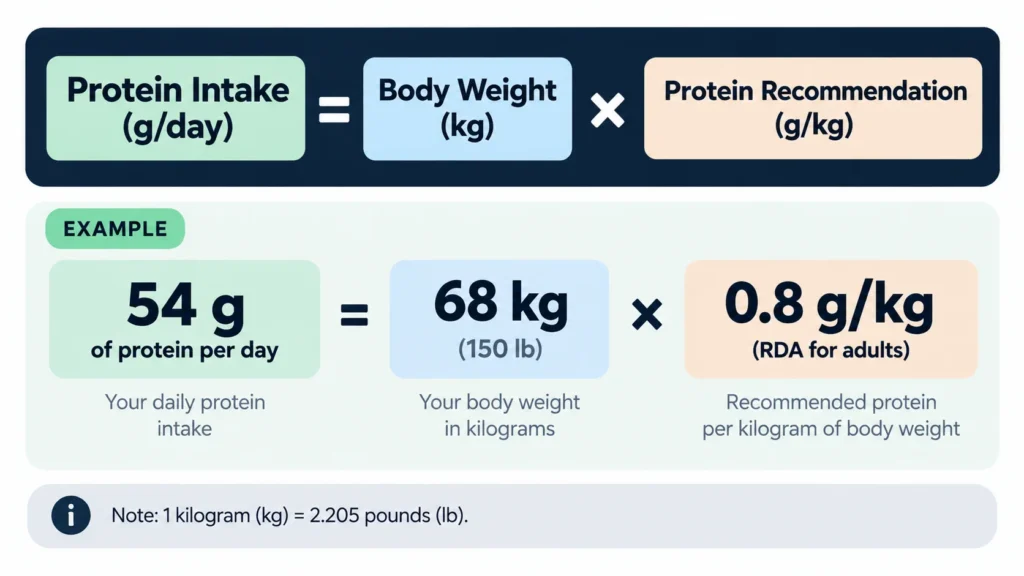
Daily protein target = body weight (kg) × protein recommendation (g/kg)
For example, a 150-pound person weighs approximately 68 kg.
Using the U.S. Recommended Dietary Allowance (RDA) of 0.8 grams of protein per kilogram of body weight per day:
68 kg × 0.8 g/kg = about 54 grams of protein per day
The 0.8 g/kg figure is the RDA established for healthy adults by the National Academies. It represents the recommended intake for generally healthy adults, rather than a universal target for people with specific fitness goals.
Why Isn’t 0.8 g/kg Right for Everyone?
The RDA provides a general baseline, but protein needs can vary depending on the individual.
Someone who regularly exercises, for example, may require more protein than a sedentary adult.
The American College of Sports Medicine (ACSM) has cited a range of approximately 1.2–2.0 g/kg/day for athletes and routinely active adults.
The International Society of Sports Nutrition has similarly stated that 1.4–2.0 g/kg/day is an appropriate range for physically active individuals, with the appropriate amount depending on the type and intensity of training.
That means two people who weigh exactly the same amount may still have different protein targets.
Example
Imagine two 180-pound adults.
Both weigh approximately 82 kg.
Person A:
Mostly sedentary → a general baseline might start around 0.8 g/kg.
Person B:
Regularly performs resistance training → a higher protein intake may be appropriate.
Using 1.6 g/kg for the second example:
82 kg × 1.6 g/kg = about 131 g of protein per day
These calculations are examples rather than personalized medical recommendations. Individual needs can vary.
How Age Can Affect Protein Needs
Age is another factor to consider.
Research and expert groups have recommended higher protein intakes for many older adults. The PROT-AGE Study Group recommends approximately 1.0–1.2 g/kg/day for healthy adults over 65, with higher amounts sometimes recommended for older adults who are physically active or dealing with illness.
The American College of Sports Medicine likewise recommends approximately 1.0–1.2 g/kg/day for adults over 50, with needs potentially increasing with heavier training.
This is one reason a useful protein calculation should consider more than body weight alone.
Why Your Goal Matters
Protein requirements can also be considered in the context of what you are trying to accomplish.
Someone may be trying to:
- Maintain their current weight and muscle mass
- Lose body fat while maintaining lean mass
- Build muscle through resistance training
- Support an active lifestyle
Rather than copying another person’s protein target, it makes more sense to start with your own body weight and circumstances.
How to Calculate Your Protein Intake
The calculation itself is simple:
1. Convert your weight to kilograms.
If you use pounds:
Weight in kg = weight in pounds ÷ 2.205
2. Choose an appropriate protein range.
For a healthy adult, the general RDA is 0.8 g/kg/day. Active adults may require more, depending on their training and goals.
3. Multiply your weight in kilograms by your protein target.
For example:
180 lb ÷ 2.205 = 81.6 kg
At 1.6 g/kg:
81.6 × 1.6 = approximately 131 g/day
The Easier Way: Use a Protein Calculator
You don’t have to do the calculations yourself.
A protein calculator can take information such as your weight, age, activity level, and goal and use it to estimate an appropriate daily protein target.
If you want to calculate your own target, you can use the Protein Calculator to get a personalized estimate based on your information.
Important note
Protein requirements can be affected by medical conditions, kidney disease, pregnancy, age, training status, and other individual factors. The calculations above are intended for general educational purposes and should not replace advice from a qualified healthcare professional or registered dietitian.
Sources & References
- National Academies of Sciences, Engineering, and Medicine — Dietary Reference Intakes
Provides the framework for U.S. dietary reference values, including the Recommended Dietary Allowance for protein.
National Academies — Dietary Reference Intakes - American College of Sports Medicine — Protein Intake for Optimal Muscle Maintenance
Provides guidance on protein intake for people who regularly participate in resistance training and endurance activities.
ACSM — Protein Intake for Optimal Muscle Maintenance - Bauer et al. — PROT-AGE Study Group
Peer-reviewed recommendations concerning protein intake in older adults.
PubMed — Evidence-Based Recommendations for Optimal Dietary Protein Intake in Older People - Jäger et al. — International Society of Sports Nutrition Position Stand
Reviews evidence concerning protein intake and exercise.
Journal of the International Society of Sports Nutrition