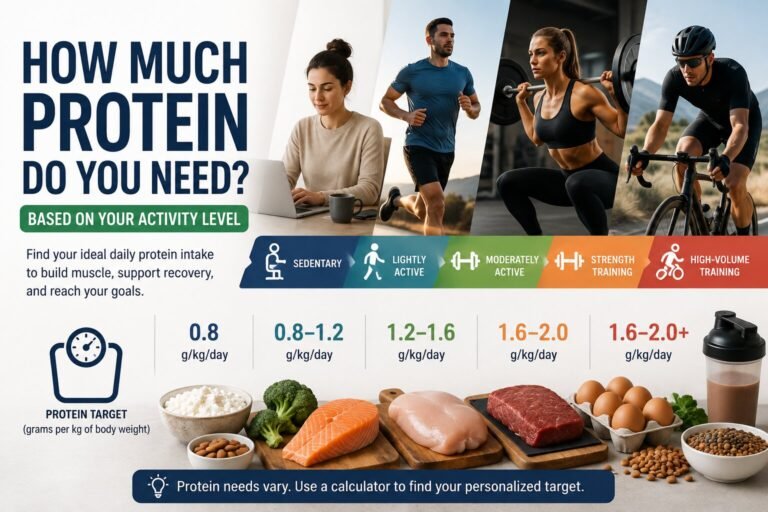
The answer isn’t the same for everyone.
Your ideal protein intake depends on several factors, including your body weight, training intensity, age, calorie intake, and overall goal. Someone training for muscle growth five days a week will generally have different protein needs than someone who exercises occasionally.
Research consistently shows that consuming enough protein, combined with regular resistance training, supports muscle repair and helps stimulate muscle protein synthesis—the process your body uses to build and maintain lean muscle tissue.
If your goal is to maximize muscle growth, this guide explains, this guide will atleast help you figure out an estimate about your protein intake. We have researched this article and tried to bring you a scientific estimate about the intake.
If you’d rather skip the calculations, you can also use our Protein Calculator to estimate your daily protein needs in less than a minute.
Quick Answer
How Much Protein Do You Need to Build Muscle?
For most healthy adults who perform regular strength training, a daily protein intake of approximately 1.6–2.2 g/kg (or 0.7–1.0 g/lb) of body weight is recommended to maximize muscle growth and recovery.
For example:
These values provide a practical starting point. Your ideal intake may be higher or lower depending on your training volume, calorie intake, recovery, age, and individual response.
| Training Goal | Recommended Protein Intake |
|---|---|
| Build Muscle | 1.6–2.2 g/kg (0.7–1.0 g/lb) |
| Strength Training | Same recommendation |
| Advanced Lifters | Up to 2.2 g/kg may be beneficial |
These values provide a practical starting point. Your ideal intake may vary depending on your training volume, calorie intake, recovery, age, and individual response.
How to Calculate Your Protein Needs
A simple way to estimate your daily protein intake is to multiply your body weight by 1.6–2.2 grams per kilogram.
Example 1
Weight: 70 kg
Protein:
70 × 1.6 = 112 g
70 × 2.2 = 154 g
Recommended intake:
112–154 grams per day
Example 2
Weight: 180 lb
Protein:
180 × 0.7 = 126 g
180 × 1.0 = 180 g
Recommended intake:
126–180 grams per day
These values are general recommendations for healthy adults who regularly perform resistance training. Individual needs can vary depending on age, training volume, calorie intake, and overall health.
Or you could do one of the easiest methods of using our very own Protein Calculator , which gives you an accurate estimation about how much protein you should have to build muscle.
Why Protein Matters for Muscle Growth
Every time you complete a challenging strength workout, your muscles experience tiny amounts of stress and damage. During recovery, your body repairs this tissue, making it stronger and, over time, larger. This process is known as muscle hypertrophy.
Protein provides the amino acids your body needs to repair and build muscle tissue. Without enough protein, your body has fewer building blocks available for recovery, which may limit your progress even if you’re training consistently.
One amino acid, leucine, plays a particularly important role because it helps trigger muscle protein synthesis (MPS). MPS is the biological process responsible for repairing damaged muscle fibers and supporting new muscle growth after exercise.
However, protein alone won’t build muscle.
The best results come from combining:
- Progressive resistance training
- Adequate daily protein intake
- Sufficient calories to support your goal
- Quality sleep and recovery
- Consistent training over time
Think of resistance training as the signal that tells your body to build muscle, while protein provides many of the raw materials needed to respond to that signal.
Does Protein Timing Matter?
Meeting your total daily protein goal is generally more important than consuming protein at a specific time.
That said, distributing protein across three to five meals during the day may support muscle protein synthesis more effectively than eating most of it in a single meal.¹
Many people also choose to consume a protein-rich meal within a couple of hours after resistance training as a practical way to support recovery.
Is More Protein Always Better?
Not necessarily.
Once you consistently meet your daily protein needs, eating substantially more protein is unlikely to produce additional muscle growth on its own.
Research suggests that for most people performing resistance training, increasing protein intake beyond approximately 2.2 g/kg of body weight per day offers little extra benefit for muscle gain. That doesn’t mean extra protein is harmful for healthy individuals, but it does mean that other factors—such as training quality, total calorie intake, recovery, and consistency—become more important.
A balanced approach is usually more effective than simply trying to consume as much protein as possible.
References
- Jäger R, Kerksick CM, Campbell BI, et al. International Society of Sports Nutrition Position Stand: Protein and Exercise. Journal of the International Society of Sports Nutrition. 2017. View Study
- Morton RW, Murphy KT, McKellar SR, et al. A Systematic Review, Meta-analysis and Meta-regression of the Effect of Protein Supplementation on Resistance Training–Induced Gains in Muscle Mass and Strength in Healthy Adults. British Journal of Sports Medicine. 2018. View Study
- Thomas DT, Erdman KA, Burke LM. Position of the Academy of Nutrition and Dietetics, Dietitians of Canada, and the American College of Sports Medicine: Nutrition and Athletic Performance. Journal of the Academy of Nutrition and Dietetics. View Study
- U.S. Department of Agriculture. FoodData Central. Visit FoodData Central