Quick answer: If you weigh 200 pounds, a practical daily protein target is about 109–145 grams under current U.S. guidance. If you lift weights regularly and want to build or preserve muscle, your needs may be closer to 127–181 grams per day.
That is a wide range, but there is a reason for it: your body weight is only one part of the calculation. Your activity level, training, age, calorie intake, health, and goal all affect where you should land.
The short answer
A 200-pound person weighs approximately 90.7 kilograms. The Dietary Guidelines for Americans, 2025–2030 set a general protein target of 1.2–1.6 grams per kilogram of body weight per day.
For most healthy 200-pound adults, 109–145 grams is a sensible range to start with. You do not automatically need 200 grams simply because you weigh 200 pounds.
Protein targets for a 200-pound person
| Goal or reference point | Protein per kilogram | Protein per pound | Daily amount |
|---|---|---|---|
| Traditional adult RDA | 0.8 g/kg | 0.36 g/lb | About 73 g |
| Current U.S. dietary target | 1.2–1.6 g/kg | 0.54–0.73 g/lb | About 109–145 g |
| Resistance training or muscle gain | 1.4–2.0 g/kg | 0.64–0.91 g/lb | About 127–181 g |
The numbers describe different things. The traditional RDA is a baseline intended to cover the needs of nearly all healthy adults. The National Academies’ Dietary Reference Intakes set that adult protein RDA at 0.8 g/kg. It is not necessarily the ideal target for maximizing muscle growth, improving workout recovery, or preserving lean mass while dieting.
The newer federal guidance gives a higher general target of 1.2–1.6 g/kg. Meanwhile, the International Society of Sports Nutrition recommends 1.4–2.0 g/kg for most exercising people who want to build or maintain muscle.
How much protein does a 200-pound person need to build muscle?
For a 200-pound person who strength trains consistently, a research-supported range is approximately 127–181 grams of protein per day.
You probably do not need to begin at the top of that range. A realistic starting target is around 130–150 grams per day, particularly if you are new to lifting or currently eat much less protein. You can then adjust based on your training volume, calorie intake, progress, appetite, and advice from a qualified professional.
Protein supplies the amino acids needed to repair and build muscle, but more protein cannot replace progressive resistance training.
Total daily intake also matters more than chasing a tiny post-workout window. The sports-nutrition position stand recommends spreading protein across the day, generally in 20–40 gram servings every three to four hours.
How much protein does a 200-pound person need to lose weight?
If your goal is fat loss, about 109–145 grams per day is a reasonable starting range for many healthy 200-pound adults. The upper half of that range may be useful if you also lift weights and want to preserve muscle while eating fewer calories.
Protein-rich meals can make a calorie-controlled diet easier to follow because they are often filling. More importantly, combining adequate protein with resistance training gives your body a stronger reason to retain lean mass during weight loss.
Is 73 grams of protein enough at 200 pounds?
About 73 grams per day is what the traditional 0.8 g/kg RDA calculation gives for a 200-pound adult:
That does not mean 73 grams is the best target for every 200-pound person. It is better understood as a basic reference point. It falls below the current U.S. dietary target and may be less than ideal for someone who trains hard, is trying to gain muscle, or is dieting while trying to maintain lean mass.
If you currently eat around 70 grams, you do not need to jump to 145 grams overnight. Add 20–30 grams per day first and see how the change fits your appetite and routine.
Do you need one gram of protein per pound?
The popular “one gram per pound” rule would give a 200-pound person 200 grams of protein per day. That equals about 2.2 g/kg.
For most people, that is more than necessary. It sits above the current U.S. dietary target and slightly above the 1.4–2.0 g/kg range considered sufficient for most exercising individuals.
Some athletes may intentionally eat around that amount under specific circumstances, but it should not be treated as a universal rule. A target you can meet consistently with a balanced diet is more useful than an extreme number that crowds out fruits, vegetables, whole grains, and healthy fats.
How to eat 130–145 grams without making every meal enormous
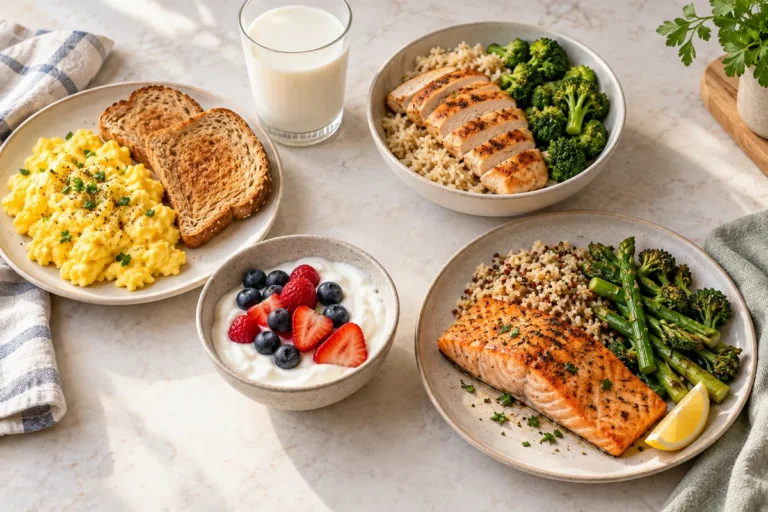
The easiest approach is to divide your target before choosing your food. For example, a 140-gram day could look like this:
You can reach those meal targets with many combinations of food. Eggs, Greek yogurt, cottage cheese, milk, poultry, fish, lean meat, tofu, tempeh, beans, lentils, edamame, nuts, and seeds can all contribute. Protein powder can be convenient, but it is not required if whole foods cover your needs.
A simple way to choose your target
- Generally healthy with no structured training: Start around 110 grams per day.
- Active or exercising several times per week: Start around 125–145 grams per day.
- Strength training with a muscle-building goal: Start around 145 grams, then adjust within the 127–181 gram range if needed.
- Losing weight while lifting: Consider 130–150 grams, provided it fits your calorie needs and medical situation.
These are starting estimates, not prescriptions. Consistency, overall diet quality, and your response over time matter more than hitting the exact same number every day.
Find your daily protein target
Use your weight, activity level, and goal to get a personalized protein range in less than a minute.
When to get personalized advice
General protein formulas are designed for broadly healthy adults. Speak with a physician or registered dietitian before making a major change if you have chronic kidney disease, receive dialysis, are pregnant or breastfeeding, have a history of disordered eating, or have another condition that affects your nutritional needs.
Frequently asked questions
How much protein should a 200-pound man eat?
How much protein should a 200-pound woman eat?
Is 100 grams of protein enough for a 200-pound person?
Is 150 grams enough to build muscle at 200 pounds?
Is 200 grams of protein too much?
The bottom line
A 200-pound adult should generally aim for about 109–145 grams per day. Someone who lifts regularly may use a broader target of 127–181 grams, although the middle of that range is enough for many people.
Start with a number that matches your goal, spread it across meals, and focus on a varied diet rather than forcing in as much protein as possible. The best target is not the highest one—it is the one that supports your health and training and that you can follow consistently.
This article is for general educational purposes and is not a substitute for individualized medical or nutrition advice.
Sources
- Dietary Guidelines for Americans, 2025–2030, HHS and USDA.
- Dietary Reference Intakes for Energy and Macronutrients, National Academies.
- ISSN Position Stand: Protein and Exercise.
- Healthy Eating for Adults with Chronic Kidney Disease, NIDDK.