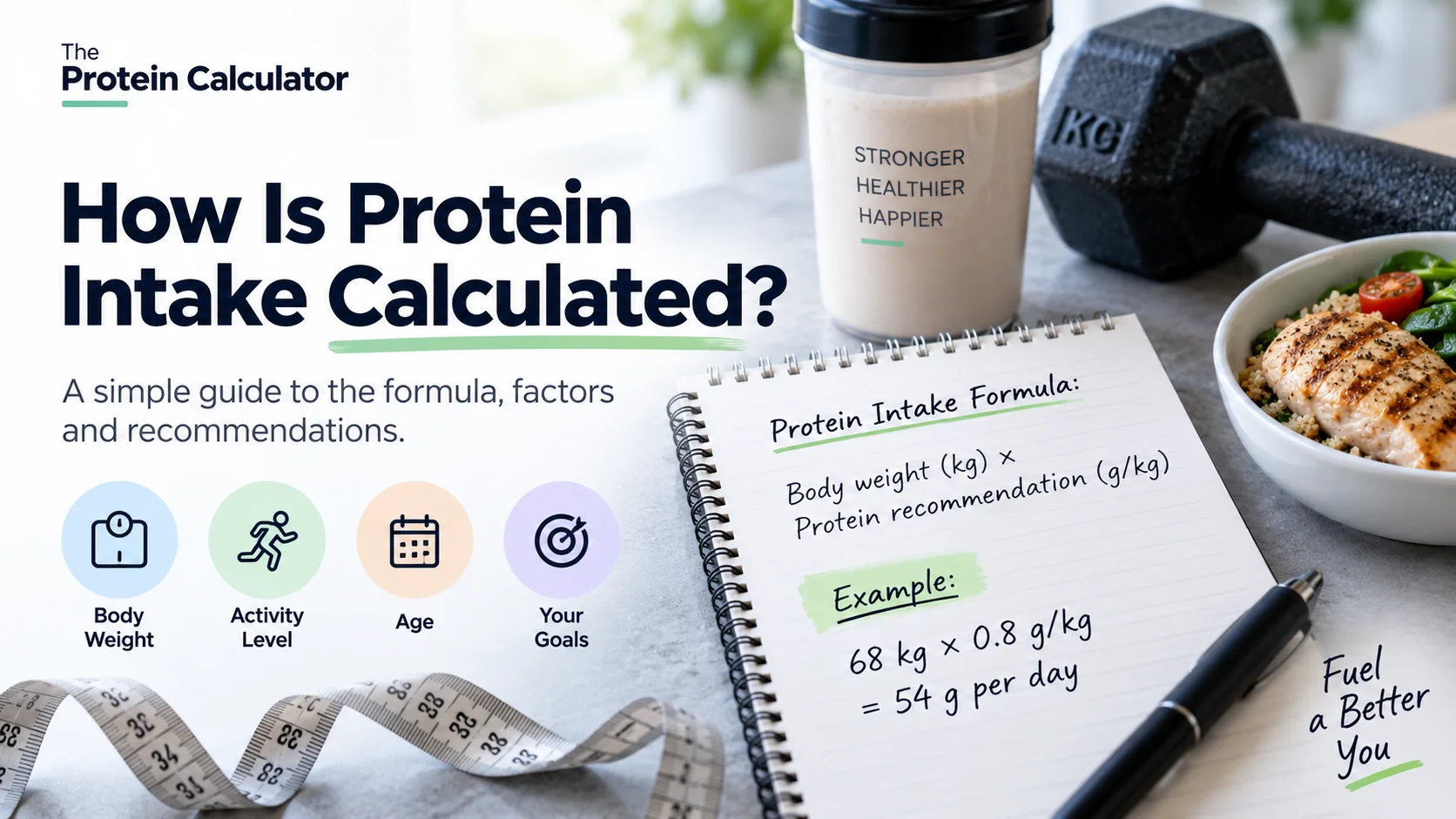
Daily protein intake is usually estimated from body weight and a protein factor expressed as grams per kilogram of body weight per day (g/kg/day). The calculation is simple, but choosing the factor requires context: the general adult RDA, regular training and older age are not the same situation.
The Protein Intake Formula
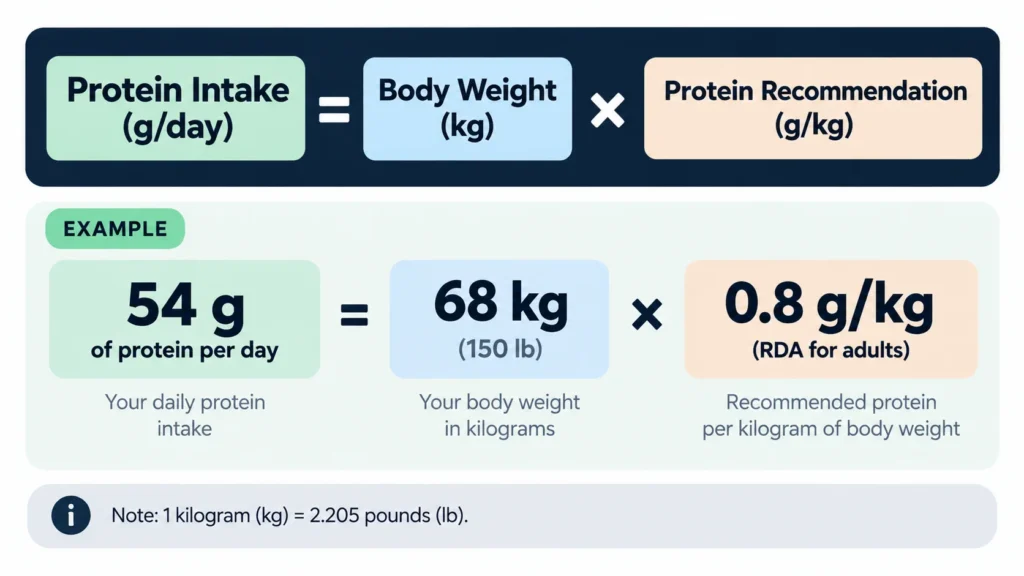
Daily protein (g/day) = body weight (kg) × protein factor (g/kg/day)
The units cancel cleanly: kilograms of body weight multiplied by grams per kilogram leaves grams per day. Keep the decimals during the calculation and round the final result to the nearest whole gram.
| Term | Meaning | Example |
|---|---|---|
| kg | Body weight in kilograms | 70 kg |
| g/kg/day | Grams of protein for each kilogram of body weight each day | 1.6 g/kg/day |
| g/day | Estimated total protein for the day | 70 × 1.6 = 112 g/day |
Step 1: Convert Pounds to Kilograms
If your weight is already in kilograms, skip this step. If you use pounds:
Weight in kilograms = weight in pounds ÷ 2.2046
For example, 150 lb ÷ 2.2046 = 68.0 kg. Using 2.2 is acceptable for a quick estimate, but 2.2046 gives a slightly more precise conversion.
Step 2: Choose an Appropriate Protein Factor
There is no single multiplier for every adult. The ranges below summarize the sources used in this guide.
| Situation | Protein factor | How to interpret it |
|---|---|---|
| Generally healthy adult baseline | 0.8 g/kg/day | The U.S. adult Recommended Dietary Allowance (RDA), designed to meet the needs of nearly all healthy adults. It is a population reference value, not an athletic target. |
| Regular exercise or sports training | 1.4–2.0 g/kg/day | The ISSN position stand describes this range as sufficient for most exercising people; training volume, energy intake and goals affect where someone may fall within it. |
| Healthy adults over 65 | 1.0–1.2 g/kg/day | The PROT-AGE position paper recommends this range for many healthy older adults. Illness, activity and kidney function can change the appropriate amount. |
These categories can overlap. An older adult who strength trains, for example, should not automatically combine or add the multipliers. A registered dietitian or qualified clinician can help choose an appropriate target when several factors apply.
Step 3: Multiply and Round at the End
Metric example: 70 kg
For a 70 kg generally healthy adult using the 0.8 g/kg/day RDA:
70 kg × 0.8 g/kg/day = 56 g/day
For the same 70 kg person using an example training factor of 1.6 g/kg/day:
70 kg × 1.6 g/kg/day = 112 g/day
Pounds example: 150 lb
First convert pounds to kilograms:
150 lb ÷ 2.2046 = 68.0 kg
Then apply the selected factor:
68.0 kg × 0.8 g/kg/day = 54.4 g/day, rounded to about 54 g/day.
How to calculate a range
Calculate each end separately. For a 150 lb (68.0 kg) exercising adult using 1.4–2.0 g/kg/day:
| Calculation | Result |
|---|---|
| 68.0 × 1.4 | 95.2 g/day |
| 68.0 × 2.0 | 136.0 g/day |
The estimated range is therefore about 95–136 g/day. A range reflects uncertainty and different training contexts; it does not mean everyone should choose the highest number.
Use the Weight Chart for a Quick Reference
If you want to compare common body weights without repeating each calculation, open our protein intake by weight chart in pounds and kilograms. The chart uses the same weight × g/kg structure and lets you scan several example factors side by side.
Estimate Your Daily Protein Range
Enter your age, weight, activity level and goal in our calculator. Its result is an educational estimate; this manual guide explains the standard weight-based equation used to understand protein recommendations.
What the Basic Formula Assumes
- The weight basis is appropriate. The basic equation uses current total body weight. A clinician may choose a different weight basis in some medical or body-composition situations.
- The chosen factor fits the person. A multiplier for an exercising adult should not be applied automatically to someone who is sedentary, pregnant, recovering from illness or managing a medical condition.
- The result is a daily estimate. Food labels and food-composition data also involve rounding, so false precision is not useful.
- Calories and overall diet are adequate. A protein number alone does not show whether the full diet meets energy, fiber, vitamin, mineral or fat needs.
- The person is an adult. Children and teenagers have age-specific reference values and should not use this adult shortcut.
When This Formula May Not Be Appropriate
Do not use a generic fitness multiplier as medical advice. Pregnancy or breastfeeding, chronic kidney disease, liver disease, malnutrition, major illness, surgery, significant wounds, dialysis and other clinical situations can change protein requirements. Kidney needs are especially individualized: the National Institute of Diabetes and Digestive and Kidney Diseases advises people with chronic kidney disease to work with a dietitian or healthcare professional to find the right balance.
If any of these situations apply, ask a qualified healthcare professional or registered dietitian which weight and protein factor should be used.
Common Protein-Calculation Mistakes
| Mistake | Correction |
|---|---|
| Multiplying pounds directly by a g/kg factor | Convert pounds to kilograms first. |
| Writing the answer as g/kg | The final result is grams per day (g/day). |
| Rounding at every step | Keep decimals and round only the final result. |
| Using the highest athletic factor by default | Select a factor that matches training, goals and health context. |
| Assuming a calculator result is a diagnosis | Use it as an estimate and seek individualized advice when health conditions apply. |
Sources and References
- National Academies — Dietary Reference Intakes for Protein and Amino Acids
- International Society of Sports Nutrition position stand: protein and exercise
- PROT-AGE Study Group — Evidence-based protein recommendations for older adults
- NIDDK — Healthy eating for adults with chronic kidney disease
Sources and linked site pages were checked October 10, 2026.